Barkley
Where the Crawdads SingBarkley Cove is a small coastal village set between the North Carolina marshes and the Atlantic, a place whose worn buildings, sparse roads, and rigid social boundaries shape the lives unfolding there. It is Kya Clark’s nearest town and the community that turns her into the Marsh Girl: a backwater settlement close enough to judge her, yet unwilling to welcome the abandoned child it has helped leave alone.
Setting and Physical Character
Everglades and ocean enclose Barkley Cove, their salt haze meeting around the village. At high tide the sea swells on the far side of Main Street, while the marsh and water together separate the town from the rest of the world. A single-lane highway, cracked and pitted, provides its only connection inland. The geography gives the settlement a sense of seclusion, but not of untouched wilderness: people, shops, docks, and homes are scattered through the estuaries and reeds.
The town has two streets. Main follows the oceanfront past a row of businesses; Broad runs from the old highway toward the ocean and ends at Main, making their junction with the Atlantic the village’s only intersection. Shops are not joined into continuous blocks. Small vacant lots, overgrown with sea oats and palmettos, leave gaps through which the marsh seems to be advancing. For more than two centuries, salty winds have weathered cedar-shingled buildings rust-red, while their white- or blue-painted window frames peel and crack. The village appears less to resist the elements than to sag beneath their pressure.
At the small bay, a wharf hung with frayed ropes and old pelicans projects into the water. When the bay is calm, it reflects the reds and yellows of shrimp boats. Dirt roads wind among small cedar houses, trees, and lagoons, then run along the ocean beyond the shops. The settlement is described as a backwater in the literal sense: its scattered pieces resemble an egret’s nest cast among the wetlands.
Streets, Commerce, and Social Boundaries
Main Street concentrates the village’s everyday commerce. The Piggly Wiggly stands at one end and Western Auto at the other, with the diner between them; other businesses include Kress’s Five and Dime, a catalog-only Penney’s, Parker’s Bakery, and a Buster Brown Shoe Shop. Beside the grocery, Dog-Gone serves hot dogs, chili, and fried shrimp. Women and children are not expected to enter, since doing so is considered improper, but a takeout window lets them order food and Nehi cola from the street. Black residents are barred from both the door and the window. The town’s small scale therefore does not make its boundaries informal: custom and race determine who can enter, order, or occupy public space.
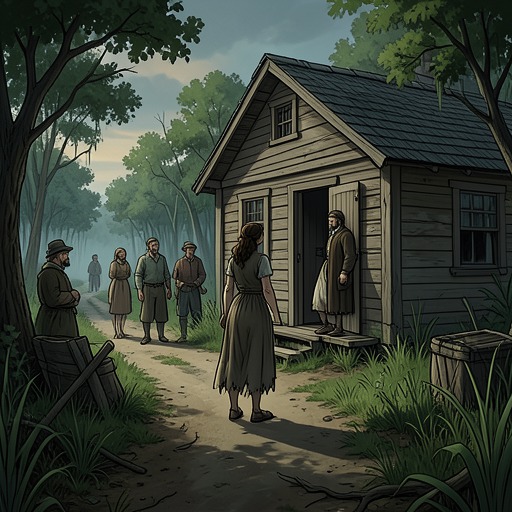
Kya’s first trip to town alone makes this social map personal. She walks four miles through deep sand and black mud to reach Barkley Cove, barefoot and wearing bib overalls too short for her. Hunger drives her onward even as she worries about facing people and managing the grocery money. Near the Five and Dime, three older boys speed past on bicycles, nearly striking her and a shopkeeper. Chase Andrews blames Kya for getting in their way; the shopkeeper rebukes the boys for shifting blame onto someone else, calling Kya swamp trash, and orders them to help a woman carry groceries. The exchange captures both the ease with which the town stigmatizes Kya and the possibility of someone briefly challenging that reflex.
Public Life and the County Seat
The waterfront also gathers the village’s public life. The Barkley Cove Diner, built in 1889, stands across a narrow street from the soggy steps of the pier. Shrimp baskets, discarded nets, and mollusk shells mark the space outside; the smell of sausage and biscuits, turnip greens, and fried chicken competes with the fish barrels on the dock. When the sheriff enters during the investigation of Chase Andrews’s murder, every booth and most tables are occupied. The crowd’s appetite for gossip is part of the town’s response to the killing: speculation about possible suspects circulates in the diner alongside ordinary local talk.
Barkley Cove is also the county’s official governmental center. As the first village settled along this marshy stretch of the North Carolina coast, it was declared the county seat by the Crown, which built the original courthouse there in 1754. Other towns, including Sea Oaks, later grew more populous and developed, but Barkley Cove retained its official status. In the murder trial, the courthouse fills with villagers and visitors; the gallery’s understood racial division, with Black attendees restricted to the balcony, echoes the exclusions embedded in the town’s commercial spaces.
Kya and the Town’s Judgment
Barkley Cove’s relationship with Kya changes little in the years between her first journey for groceries and her murder trial. It names her as an outsider before knowing her: a girl in the shrub at the edge of Main Street, blamed by boys, and publicly described as swamp trash. Later, the nickname Marsh Girl gathers rumors that she is part wolf or a missing link between ape and man. During the trial, Tom Milton challenges the town’s account of her as a curiosity or monster: Kya was an abandoned, hungry, cold child, and the community mostly failed to offer her food, clothes, or welcome. His argument turns the town’s label back on its makers, asking whether she was excluded because she was different or became different because she was excluded.
The novel’s final courtroom departure briefly unsettles that distance. After Kya is acquitted, she thanks the people who supported her; Jumpin’ and Mabel embrace her, Tate receives her thanks, and Tom enfolds her in his arms. She also recognizes Scupper without having been introduced to him, and he gently squeezes her shoulder. As she follows Jodie out, Kya touches the courthouse cat, Sunday Justice, on the tail. Outside, she feels the sea air. The town remains the place that shunned and tried her, but this moment also gives it a small, newly visible circle of human connection.